
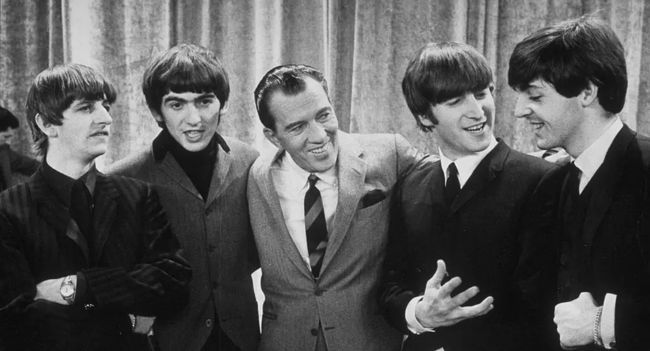
New York — February 9, 1964
Television had never carried that kind of voltage before.
At 8 p.m. Eastern Time, an estimated 73 million Americans — nearly 40% of the country — tuned into The Ed Sullivan Show. It was supposed to be another Sunday variety program. Instead, it became a cultural fault line.
When The Beatles stepped onto that stage at CBS Studio 50, they did not yet know they were about to redraw the map of modern entertainment. They were introduced politely. They smiled. They bowed. And then the first notes rang out.
What followed was not applause.
It was hysteria.
Teenage girls screamed so loudly the studio audio nearly fractured. Parents stared at the screen in disbelief. The camera struggled to hold steady as the crowd surged. In living rooms across America, families witnessed something that felt both chaotic and strangely disciplined — four young men in matching suits, hair falling just low enough to scandalize, harmonizing with surgical precision.
Ringo Starr, seated calmly behind his drum kit, anchored the storm with an almost understated confidence. Paul McCartney's melodic bass lines lifted the songs beyond simple pop. John Lennon delivered wit and edge. George Harrison projected cool restraint. Together, they felt like a self-contained universe.
They performed five songs that night.
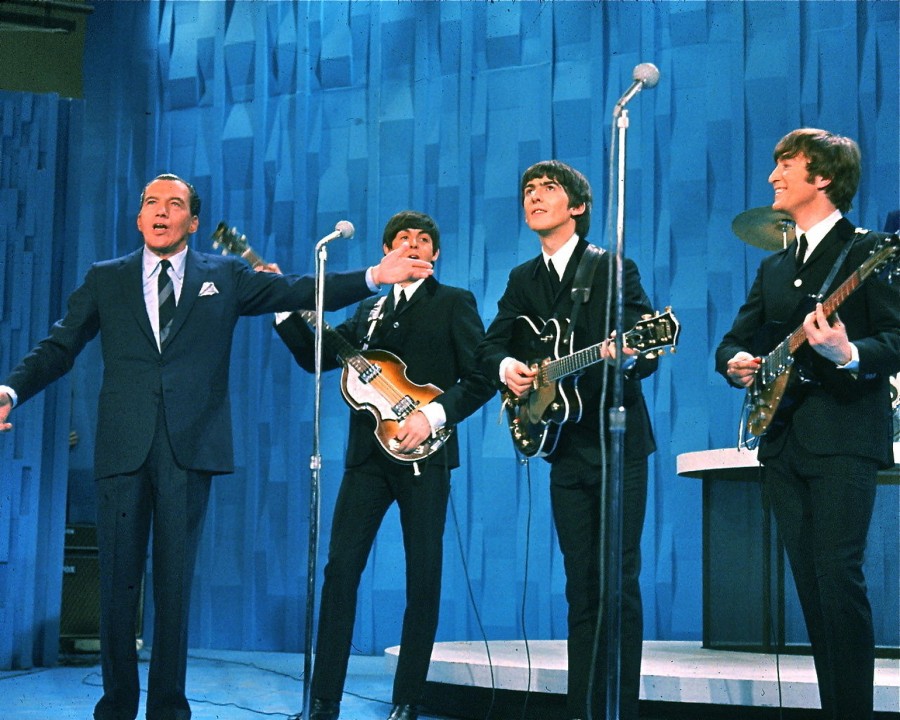
That was enough.
The impact extended far beyond record sales. The performance accelerated what would soon be labeled "The British Invasion." American charts shifted. Fashion followed. Young people began to see themselves not merely as consumers of culture, but as creators of it. The definition of youth identity sharpened overnight.
Television executives took notes. Stadium promoters took notes. Advertisers took notes. The idea that a single broadcast could transform musicians into global icons was no longer theory — it was proof.
What makes the footage remarkable today is not nostalgia, but immediacy. Even decades later, the black-and-white images pulse with urgency. The energy is unfiltered. There are no pyrotechnics, no LED walls, no choreographed spectacle. Just instruments, microphones, and presence.

Modern pop superstardom — the global tours, the mass fandom, the viral phenomenon model — can trace a direct lineage to that night. February 9, 1964, established the blueprint: television amplification, youth devotion, cultural disruption.
It was not simply a performance.
It was a pivot point.
And more than six decades later, the echo remains unmistakable.