

London, England — March 2026
The public story of The Beatles has always been told in large images. Stadiums, studio sessions, revolutions in sound, the screaming force of Beatlemania, and the sense that four young men from Liverpool once altered the emotional weather of the modern world. But the deepest truths inside that story often live elsewhere — not in the noise, but in the silences that came after it.
One of those silences belongs to the final time Ringo Starr saw George Harrison.
By November 2001, Harrison's long illness had reduced life to its most fragile essentials. Rooms had grown quieter. Time had narrowed. The world outside still knew him as one of the defining musicians of the twentieth century, but inside those final days, fame no longer carried much meaning. What mattered were the people closest to him, and the memories they brought simply by being there.
When Ringo came to see him, he did not arrive as a former Beatle paying tribute to history.
He arrived as a friend.

That distinction changes everything.
It is easy, from a distance, to imagine moments like these as heavy with symbolism, as though the room itself must have been full of unspoken references to songs, albums, decades of public life. But the emotional truth is usually much quieter. In the presence of real endings, mythology falls away quickly. What remains are older things: familiarity, shared beginnings, the private language built between people who have already lived most of their lives in one another's orbit.
That is what gives the moment its force.
Accounts of Harrison's final days often carry a strange stillness. He was said to be calm, reflective, even peaceful in a way that surprised some of those closest to him. Years of spiritual searching had shaped the emotional register of his final chapter. There was pain, certainly, but also acceptance — a sense that he had come to a place beyond resistance.
For Ringo, stepping into that room meant stepping out of the public narrative and back into something much older.
Before the records, before the films, before the endless retelling of the Beatles story, there had been friendship. Liverpool. Youth. Long nights, uncertain futures, and the early fragile sense that music might carry them somewhere larger than the lives they had been given. Those beginnings were never truly erased, no matter how much history came afterward. In a room like this, they would have felt close again.
What makes a final visit so emotionally difficult is that conversation no longer moves in ordinary ways. It does not need to explain. It circles what matters. Small memories rise unexpectedly, often with more power than the grand milestones that biographies prefer to record. A laugh about youth can matter more than a global triumph. A glance can carry more than a speech.
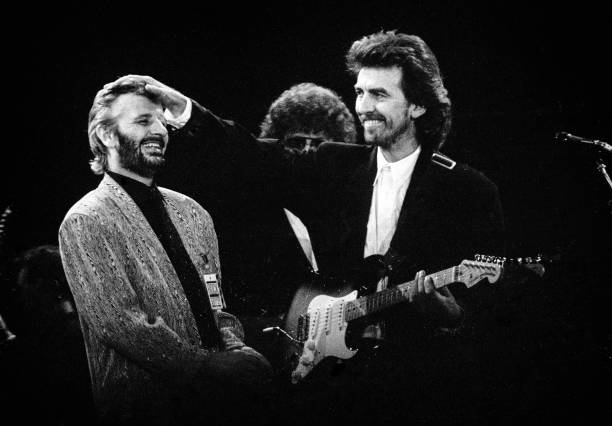
That is especially true among people who have spent decades inside the same emotional landscape.
Ringo and George had known one another through extraordinary transformation — from clubs to world fame, from creative revolution to personal change, from the closeness of being in a band to the distance that time and adulthood inevitably bring. That journey leaves behind a bond too dense for simple language. By the end, they did not need to summarize what they had been to each other. The relationship itself was the summary.
And so the power of the moment lies not in what was dramatically spoken, but in what no longer needed saying.
There were no speeches about legacy. No ceremonial farewell. No attempt to make the goodbye larger than the room could hold. Instead, there was the quiet recognition that two people who had once stood near the beginning of everything were now meeting at the far edge of it.
That kind of meeting changes the meaning of history.
From the outside, The Beatles often seem too mythic to touch. Their names belong to culture more than to ordinary life. But loss has a way of restoring human scale. It reminds us that behind every monumental story are people aging, remembering, enduring, and eventually parting from one another in rooms with no audience.
For Ringo Starr, that final visit was not a chapter designed for the public.
It was not about the band.
Not about fame.
Not about the version of the story the world prefers to celebrate.
It was about connection.

The kind that remains after success has lost its urgency and time has stripped everything down to what is simplest and truest. A shared past. A friend in the room. A silence that no longer feels empty because it is carrying too much to be broken.
When Ringo left, he did not leave with a dramatic ending.
He left with something quieter than that.
A sense of peace, perhaps.
A sense that something had settled.
A final moment between two men who had once helped change the sound of the world, and who, at the end, needed none of that history in order to understand each other.
That is why moments like this linger.
Because long after music becomes legend, friendship remains human. And in the end, it is often that humanity — not the myth — that carries the greatest weight.