

Los Angeles — February 2026
The internet did not wait for confirmation. It rarely does. Within minutes, a claim that began as scattered posts and anonymous clips swelled into a national conversation: an independent, message-driven "All-American Halftime Show" might appear during the exact Super Bowl halftime window—outside the official broadcast, beyond network control, and free from league endorsement. What transformed speculation into spectacle was not proof, but a name.
Paul McCartney.
The story gained momentum precisely because it contradicted everything the Super Bowl represents. Halftime is engineered down to the second—contracts, cues, sponsors, rehearsals. Every moment is accounted for. An unsanctioned transmission, airing in parallel and refusing the machinery of approval, sounded implausible. And yet, the idea spread faster than any official teaser ever could.
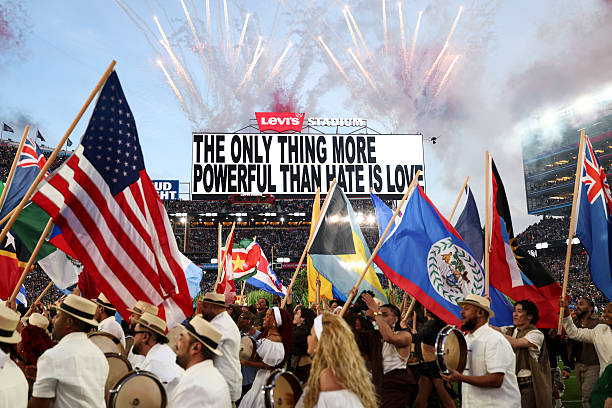
The appeal was simple: no corporate fingerprints. No scripted countdown. Just music, message, and intent. Online chatter framed it as a return to first principles—songs before spectacle, meaning before metrics. In that framing, McCartney's name felt inevitable. Across generations and genres, he remains one of the few figures whose presence implies continuity rather than controversy, substance rather than stunt.
Industry insiders were careful with language. There were no confirmations, no denials—only silence. Networks declined comment. League spokespeople offered nothing on the record. That quiet, in the modern attention economy, functioned as fuel. Without a formal response, the rumor hardened into belief for some, into debate for others, and into a referendum on what halftime should be.
Why McCartney? Because his legacy carries a particular kind of trust. He is associated with melody, restraint, and collective memory—qualities that feel increasingly scarce in a culture optimized for shock value. Supporters argued that if anyone could anchor a message-driven moment without spectacle, it would be him. Skeptics countered that the very scale of the Super Bowl makes independence a fantasy. The argument itself became the story.

As clips and captions multiplied, the conversation widened beyond logistics. Comment sections filled with familiar questions: Who controls culture? Can meaning exist outside the machine? Is authenticity possible on the biggest stage in American entertainment—or only beside it? The rumor acted as a mirror, reflecting a hunger for moments that feel earned rather than engineered.
Crucially, the narrative never depended on whether McCartney would appear. It depended on what his appearance would symbolize. Not a comeback. Not a protest. A reminder that music once traveled without permission slips—and that it could, at least in theory, do so again. In that sense, the rumor's power lay in aspiration more than accuracy.
Behind the scenes, analysts noted something else: the scale of engagement. Hundreds of millions of views accrued not around a confirmed lineup, but around an idea. That inversion—concept before content—suggested a shift in audience priorities. People were not waiting to be impressed; they were waiting to be addressed.

By the time Super Bowl Sunday approached, the rumor had already achieved its cultural effect. It reframed halftime as a question rather than a product. It positioned McCartney not as a booked act, but as a touchstone—proof that certain names still carry moral and artistic gravity in an age of rapid turnover.
Whether anything airs outside the broadcast is, ultimately, secondary. The more enduring takeaway is what the conversation revealed: a collective craving for music that speaks plainly, remembers its roots, and refuses to confuse volume with value. In an ecosystem built on permission and polish, the idea of Paul McCartney stepping into the light on his own terms—real or imagined—was enough to stop the scroll.
Sometimes, that's all a story needs to do.